Privacy & Security carries two groups and four controls. It is a short screen that does more than its length suggests. The exclude list keeps chosen senders out of processing entirely. Unknown Senders keeps mail stored and searchable but leaves it out of your briefings. A third control decides whether anyone at Brief ever reads an item you pick out.
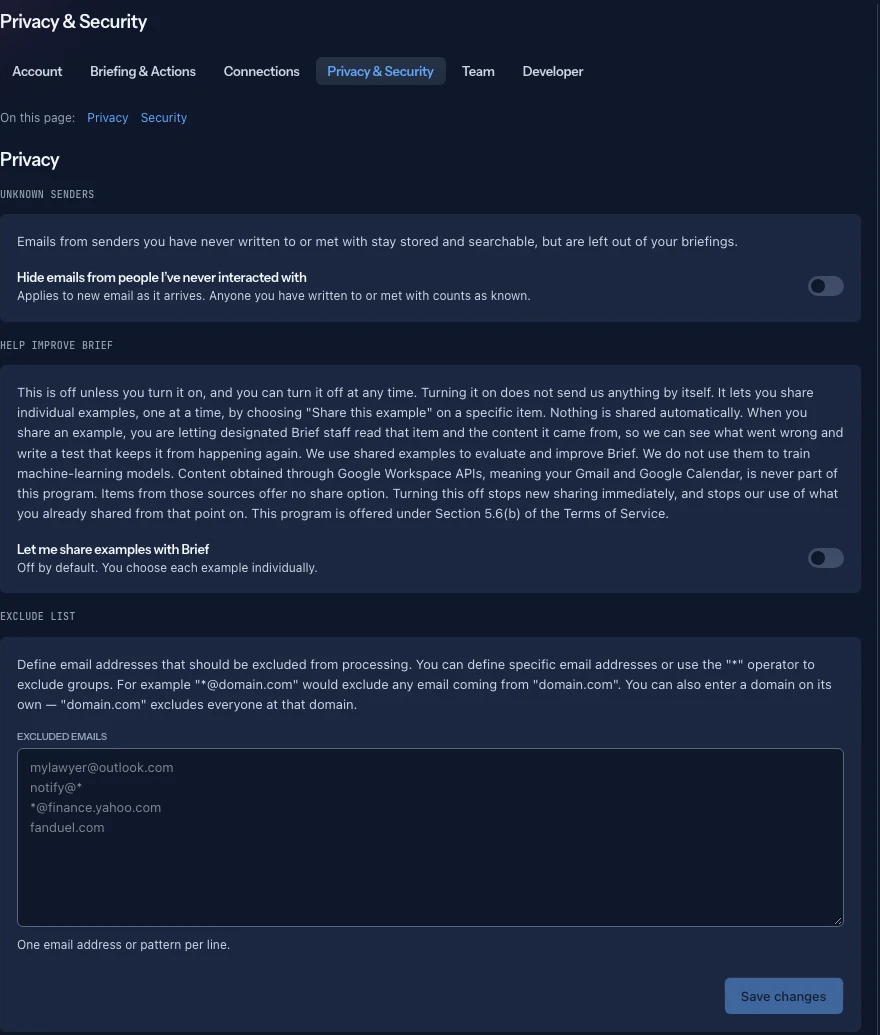
This is the screen, not the posture. For how Brief encrypts and isolates your data and which models see what, read Privacy and security.
Unknown Senders
One toggle: Hide emails from people I've never interacted with.
What it does is narrower than "hide", and the card is precise about it: "Emails from senders you have never written to or met with stay stored and searchable, but are left out of your briefings."
So nothing is deleted or ignored. A cold outreach email is still in Brief and still turns up in search — it just does not take up room in your morning read. Brief decides "never interacted with" from whether you have written to them or shared a meeting.
Turn it on if your brief keeps leading with people you have never met. Leave it off if unsolicited mail is part of your job — inbound recruiting, founder pitches, press — because then those senders are the work.
Help improve Brief
One toggle: Let me share examples with Brief. It is on for design partners, and you can turn it off at any time.
It sends us nothing on its own. What it does is keep a per-item action available: Share this example. Nothing leaves your account until you choose that action on a specific item. Turning the toggle off takes that action away, so there is nothing to choose by accident.
Where the action appears
In one place today: the notice you get when you dismiss a task suggestion.
Dismiss a suggestion and a short notice comes up with a way to undo it. Underneath it, Brief asks why, and offers five answers: Not worth tracking, Wrong, Not mine, Duplicate, Already done. Answering is optional, one tap is the whole interaction, and the question appears whether or not you are in the improvement program. Five answers rather than one "no thanks" because they are different problems. "Not worth tracking" says Brief read the item correctly and it was not worth surfacing. "Wrong", "Not mine" and "Duplicate" say it should never have been pulled out at all.
If you are in the program and that particular item can be shared, Share this example appears in the same notice. Choose it and the notice reads Shared with Brief.
Two things follow. Dismissing several suggestions in a row skips the question, because asking five times inside ten seconds is a toll booth on the thing you are repeating. And the control is not on every item in Brief: a commitment, an open question or a meeting briefing carries no share option today.
What happens to what you share
When you do share an example, you are letting designated Brief staff read that item and the content it came from. The purpose is narrow: we look at what went wrong and write a test that keeps it from happening again.
What that usually fixes is an instruction rather than a model. An item that should never have been extracted is nearly always a wording problem in the prompt that tells Brief what counts as a task or a commitment, and a shared example is what lets someone see the case and change it. We do not use shared examples to train machine-learning models, so nothing you share becomes part of one. They are used to evaluate and improve Brief, within the limits Section 5.6(b) of the Terms of Service sets.
Sharing sends the example to Brief and nowhere else. There is no way to share an item with a colleague from here.
Gmail and Google Calendar are the exception, in the other direction: those items can be shared, but only if you turned the toggle on yourself. The design-partner default does not reach them, because Google's rules require that choice to be yours, and their content is never shared in bulk.
Turning the toggle off stops new sharing immediately and stops our use of what you already shared from that point on.
Leave it on if you would rather show us a bad summary than describe one. Turn it off if any single item leaving your account is more than you want to trade for that.
Exclude List
The sharper instrument. Excluded emails takes one address or pattern per line, and these are excluded from processing rather than filtered out afterwards.
The syntax is more capable than it looks:
- A full address —
noreply@example.com— excludes that sender. - A wildcard —
*@domain.com— excludes everyone at that domain. - A bare domain —
domain.com— does the same thing. - A local-part wildcard —
notify@*— excludes that mailbox name at every domain, which is the one that catches the same robot across a dozen vendors.
The best use is machine traffic: build notifications, monitoring alerts, receipts, calendar spam. Anything that arrives constantly, is never a commitment, and is never a decision.
Take care with a bare domain that also carries real correspondence. Excluding bigcustomer.com to silence their ticketing robot also excludes the person who signs the renewal.
Sessions
Every signed-in device, the current one carrying a This device tag, and two ways out.
Log out ends the session you are using. Log out everywhere ends every other one and leaves you signed in here. Both confirm first, and the confirmation is what spells out which is which — "Log out this session?" against "Log out of all other devices?"
The second is what you want after losing a laptop or phone, or signing in on a machine that was not yours. It is also the right move if you ever suspect your Google or Microsoft account was compromised — end the Brief sessions, then fix the account at the provider, since that is where Brief's sign-in actually lives.
If a session simply looks unfamiliar, check it against how you use Brief before assuming the worst: a phone browser, a work laptop, and a home desktop are three sessions from one person.